Wednesday, March 25, 2020

Facial Recognition: Balancing Security vs. Privacy

Airports across the globe are increasingly leveraging facial recognition technology to verify and authenticate passengers. But some privacy advocates have raised concerns, especially in India, where several airports are ramping up facial recognition programs.
The technology has been introduced in recent years at some airports in the U.S., U.K., Japan, Dubai and elsewhere. In India, several airports - including those in Bangalore, Delhi and Hyderabad - are now rolling out the technology for use by passengers on a voluntary basis.
Some privacy experts in India express strong concerns that the nation lacks privacy regulations that would impose penalties for the misuse of the biometric data by the government or private industry.
"The biggest challenge is ensuring data privacy of the passengers, as the data garnered through biometrics is vulnerable and can be commercially exploited and sold if there is not tighter security controls and it's not governed appropriately," says Rahul Sharma, country president, India, at the International Association of Privacy Professionals.
A major concern is that facial recognition data gathered at airports might be used by the government for research or offered for sale for use by private industry without passengers' permission, says Brian Brackeen, CEO at Kairos, a Singapore-based software company.
Given the potential impact of artificial intelligence, including facial recognition, on society, Alan Woodward, a computer science professor at the University of Surrey, says the time for robust public debate is now.
"I personally think there should be a much greater public discussion about the use of AI in a variety of fields: law enforcement, medicine, transportation and many others," he says. "Each has safety implications and that at the very least should cause scrutiny."
Indian Airport Activity
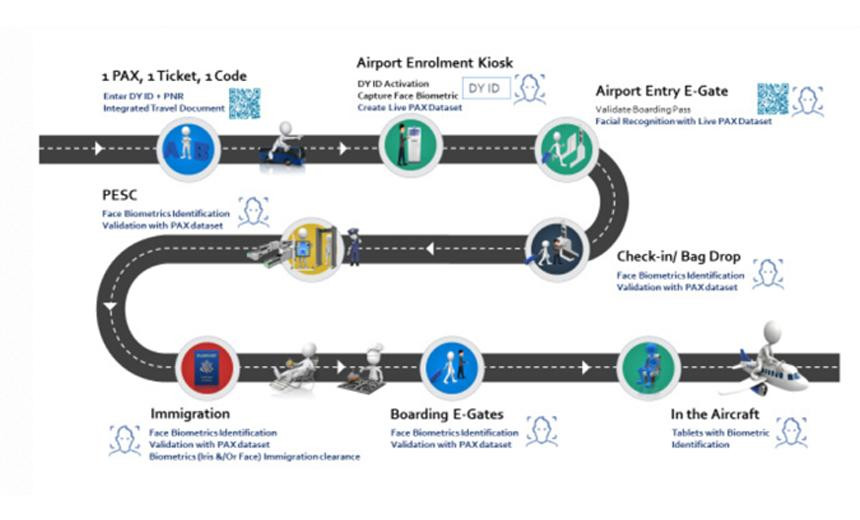
Certain airports in India, including those in Bangalore, Hyderabad and Delhi, have begun the process of authenticating passengers voluntarily through facial recognition, which is part of their digital transformation journey. Airports in Pune, Kolkata and Cochin are the next in line for this technology.
The initiative of implementing facial recognition at India's airports, known as the Digi Yatra Policy, is overseen by the Ministry of Civil Aviation, which says its goal is to offer air passengers a "seamless, hassle-free and paperless journey experience."
The Digi Yatra Policy states that once passengers submit official proof of identification, an image of their face is scanned. "If the passenger chooses to register through Aadhaar, then images of their face and iris are captured and matched with their Aadhaar biometrics," says Suresh M. Khadakbhavi, CISO at Bangalore International Airport. "Once confirmed, the passenger receives a 72-character token number from Unique Identification Authority of India. This token gets stored on the passenger's profile."
Nandita Mathur, chief strategy officer and head of engineering, at Q3 Technologies, a biometric facial recognition solutions provider, says the technology has undergone vast improvements.
"We first capture full-attention images of persons whom we are going to recognize through facial recognition system," she explains. "A database is then created with face encodings of the images [128 landmark points are used for face encodings]."
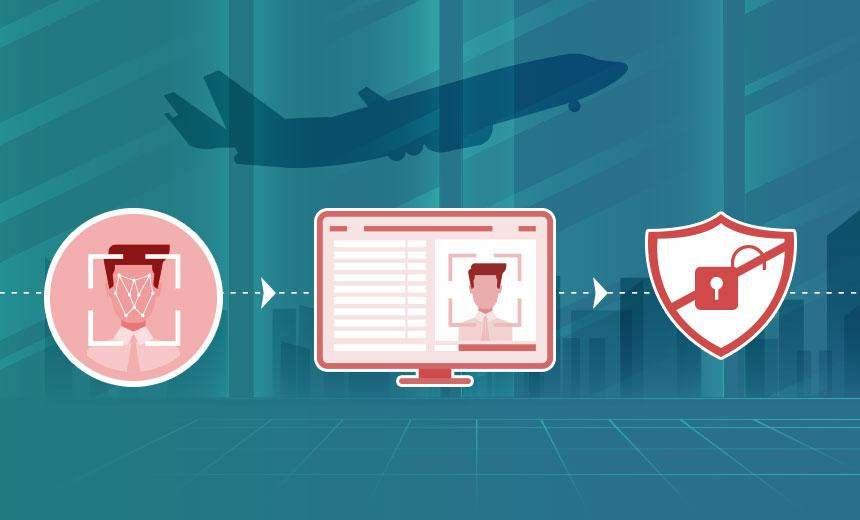
With real-time video stream, frames are captured and are ingested in a machine learning algorithm, Mathur says. "In every frame, the algorithm recognizes faces and extracts individual face images for further analysis," she says.
Khadakbhav, the airport CISO, says the Digi Yatra program is designed keeping in mind the fundamentals of privacy.
"The data is stored with airports only until a certain time, post which the data gets purged out of the system," he says. "As airport operator, we will not store your data but the profile gets stored in a Digi Yatra central platform, which is secure platform."
The Global Scenario
In the United States, Delta Airlines launched an end-to-end to biometric terminal leveraging facial recognition for international departures at Atlanta's Hartsfield-Jackson Airline in November 2018, the airline says.
Facial recognition projects are in various stages at airports in San Jose, California; Orlando, Florida; Miami, Los Angeles and New York among others, according to Business Traveller.
Tokyo Narita Airport aims to introduce facial recognition in spring of 2020, according to a report in Japan Times. Facial scans will be captured at a self-service kiosk.
In Qatar, Hamad International Airport is introducing an end-to-end biometric system, while Dubai International has been working with Emirates on a "smart tunnel," Business Traveller reports.
"Our approach to identity management is unique and holistic, in that we foresee widescale deployment of biometric capability across both mandated and voluntary passenger touch points while addressing customer data privacy concerns in line with relevant local and international regulations," Badr Mohamed al-Meer, COO at Hamad International Airport, told the news media last month.
The International Air Transport Association says some 71 percent of airlines and 77 percent of airports worldwide are investing in a biometrics program.
"Biometric recognition using the One ID concept modernizes the airport experience for passengers and improves the efficiency and security of identification processes," IATA Director General and CEO Alexandre de Juniac tells Business Traveller. "Using global standards for digital identity and data exchange will move us a big step closer to a hassle-free airport experience for passengers."
Privacy Concerns
But privacy advocates say the use of facial recognition technology at airports raises serious concerns.
"Facial recognition presents numerous challenges in today's context in India, primarily because this technology can violate people's right to privacy," says Pavan Duggal, cybersecurity advocate and chairman of International Commission on Cybersecurity Law. "Right now, there is no legal framework that regulates or enables the use of facial recognition," Duggal tells Indian news media outlet News18.
But India's Ministry of Electronics and Information Technology had earlier stated that in the absence of any law around data protection, data will be regulated according to Section 43A of the Information Technology Act, 2008. It states that a "body corporate" will pay compensation up to Rs 5 crore ($705,000) when it is "negligent in implementing and maintaining reasonable security practices and procedures and thereby causes wrongful loss or wrongful gain to any person."
Sharma of the IAPP points out, however, that "this applies only to private companies. What happens if the government is at fault? We definitely need a better and more evolved law which takes into account all stakeholders involved."
Civil Liberties Issues
Facial recognition poses a potential threat to basic civil liberties, privacy advocates argue.
"People don't expect to have their identity, their location, and who they associate with logged every time they step outside and walk down the street," says Matt Cagle, an attorney for the Northern California chapter of the American Civil Liberties Union. "That's the kind of world that automated face surveillance would usher in," he tells the Los Angeles Times.
Khadakbhavi, the CISO at Bangalore International Airport, offers this response: "Of course a law around privacy will give more confidence to users and keep away privacy concerns. But for now, we are confident of the security measures we have implemented."
Facial recognition data is encrypted and only temporarily stored, he notes. The Bangalore airport has implemented a series of security measures to ensure proper implementation of the technology as well as sanctity of data. Khadakbhav explains the security measures taken to safeguard data in the platform: "The data is stored in a way that a hacker will not get name and phone number of a passenger together. Also, only certified devices can have access to data." So far, only Air Vistara has agreed to participate in government's Digi Yatra facial recognition program.

Webinar Chatbots | Reinventing the Way Your Business Interacts with the World


Chatbots: Reinventing the Way Your Business Interacts with the World
Digital Transformation has become the new Epi-Center of Technology evolution, and doesn’t matter whether BIG, or not so; the organizations are aligning towards it.
Chatbot, is no new name in this Digital Transformation era. Being the most heard and in-demand technology chatbot has gained more power by utilizing Artificial Intelligence (AI) and making the interaction more focused and personalized.
From understanding the intent behind the customers’ requests to responding the queries in a natural and human centric way, AI-powered Chatbots have gone to an altogether different level by utilizing Machine Learning (ML) and Natural Language Processing (NLP) techniques.
Register for the webinar and join us to discover how Chatbots can help you overcome business challenges to deliver immediate and measurable ROI. 
Key Takeaways from the Webinar:-
·              How Chatbots are making the impact by re-defining the way of interactions
·              How Artificial Intelligence is adding more power to Chatbots and making it best suited for your business needs
·              How to overcome challenges/limitations faced by the organizations during Chatbot implementations
·              The best practices to implement Chatbot for your business in the most efficient & flawless way
·              Where the world of Chatbots is moving and what’s in future?
Let’s explore how Bots can help to grow your Business & Brand-Value.

source url : https://www.q3tech.com/webinar-chatbots-reinventing-the-way-your-business-interacts-with-the-world-emea/

Leveraging Enterprise Digital Transformation with Technology


The Indian market is gradually maturing towards adopting cutting-edge IT solutions, and technologies as Artificial Intelligence and Machine Learning is here to stay and evolve. There are several applications which involves such technologies finds usage in the fields of camera vision, facial recognition and object identification augmented analytics with the help of trends and behavioral patterns and predictive modeling, will find their way and exist in the long run, in several government pet policies, asserted Anuj Mathur, CEO, Q3 Technologies in a conversation with Poulami Chakraborty of BW SmartCities. Excerpts below:


Having catered to the enterprise sector, what has been you're an observation about the Indian market’s trends for IT adaptation in the enterprise sector?
We have seen tremendous adoption of IT in the Indian enterprise sector over the last decade led with what has primarily been a mobile-first strategy.  If we look back about two decades, India was lagging quite heavily in this space compared to Western economies where various IT solutions especially ERP, SCM and enterprise IT solutions were implemented on a large scale. 
All of that changed with the advent of initially the web and more significantly the smartphones. The rapid adoption of smartphones triggered an equally robust adoption of IT in the enterprise sector. This is also reflected in the fact that while a decade ago, our entire customer-base was outside India, today we have a much healthier 50-50 mix of Indian and Foreign clients. Q3 Technologies is doing some amazing cutting-edge work in the Indian enterprise segment with AI, ML, IoT, Chatbots, Automation, and BI-Analytics.
How is automation molding the Indian market trends according to you? Do you believe it is beneficial? Your views.
I see an aggressive push from CIOs of large Indian enterprises for automation, and that is hugely beneficial for the sector at large.
While the primary drivers for automation in the more advanced economies of the world have typically been workforce and cost-reduction related, Indian CIOs are looking at it more from the point of view of increasing productivity, enhancing efficiency and improving customer experience. The market trends therefore also reflect automation adoption in areas where employee efficiency and productivity increase can be realized. Our approach for automation is to start with a Proof of Concept (POC) for the customer, which helps in realizing the potential ROI and creates customer confidence.
Blockchain has evolved drastically in the past 5 years? Do you think that the Indian market is ready for adaptation to such a high-end tech-solution? What future do you foresee for blockchains in India?
While a number of pilots and POCs are already in the works, for India to adopt blockchain technology at scale, it will need a regulatory structure and government support. Along these lines, NITI Aayog, co-hosted the International Blockchain Congress (biggest blockchain conference in Asia) last year. Events such as these will eventually lay the groundwork for blockchain adoption in the country. 
Having said this, blockchain has the potential to be a revolutionary technology which will eventually lead to a paradigm shift in virtually all industries including Retail, Banking, Healthcare, Education, Logistics, Real Estate, and Governance. Indian customers are slowly treading the path of Blockchain adoption with smaller simpler “blockchain-inspired solutions” to understand its applicability and scale. 
Your views about Data Protection Bill?
India is very rapidly moving towards becoming a digital economy, and thus the Data Protection Bill allowing rightful and lawful possession and processing of data is a key to get us there. I think it is an excellent initiative at calling out data protection obligations while drawing on learnings from global privacy regimes and trying to remedy some of the issues. It lays down key provisions to promote transparency and hold data fiduciaries/organizations accountable for their actions. The Bill’s mandate on data localization will help Indian software services companies in the long term 
How beneficial do you think AI and ML for the Indian market? Which segments of operations do you feel has the need for these technologies more?
As the Indian market is gradually maturing towards adopting cutting-edge IT solutions, AI-ML is here to stay and evolve. It has several applications in the Indian market – many of which we are actively working with our clients. These applications are in the fields of camera vision, facial recognition and object identification, augmented analytics with the help of trends and behavioral patterns and predictive modeling (for e.g., with respect to sales and inventory forecasting and equipment maintenance and fault prevention). Another area where AI and ML are being extensively used is in Natural Language Processing (NLP) and the use of bots and chatbots.
The use of advanced digital technologies like AI and ML are allowing Indian companies to compete and win in the global marketplace.
What challenges do you come across while operating in India? How are you mitigating them?
To my mind, we do not come across any India-specific challenges that are fundamentally different from operating anywhere else in the world. Every country provides some opportunities and some challenges and we put in plans to mitigate those challenges as part of our business strategy. In fact, the overall support from the regulatory standpoint has improved drastically in the last couple of years, thus helping the Indian IT industry.
What plans of expansion does Q3 Technologies have in the pipeline?
Q3 has emerged as a serious challenger to the existing service providers in India over the last few years. With a very large number of marquee clients in India, Europe, US, APAC, and the Middle East, Q3 is poised for even greater growth momentum in the future. With the recent large investments that Q3 has made in our expansion at the Mahindra SEZ in Jaipur and our new office in the Mumbai, Q3 has aggressive expansion plans in India and in overseas markets over the next few years. We have also recently started our Sydney and Dubai sales offices, with which we now have a presence across all the major geographies
What initiatives are you taking in lines with the Government of India’s Digital India mission?
Q3 is an active member of various GOI initiatives specifically with respect to the Digital India mission. Members of our senior management team have been participating and speaking at various forums like: FICCI, CCI, and GeM where we provide industry-specific insights and participate in technology showcases and tries to give best of our contribution to GOIs agenda of Digital Transformation. We are working closely with several Government departments for developing AI-ML, Chatbots, and BI-Analytics based solutions.


Tuesday, March 17, 2020

Benefits of Robotic Process Automation in Business


All the business organizations are aligning towards the digital transformation which has become the necessity to survive the competition. The technological advancement is helping the businesses to reduce the unnecessary cost of storing the goods, streamlining operations and maintaining the proper records of receivables and payables. The Robotic Process Automation (RPA) helps in automating the business processes and delivers immediate Return on Investment. RPA has been very successful in resolving the issues of the gaming industry.

RPA refers to the using of software integrated with Machine Learning and Artificial Intelligence which helps the business organizations in handling the high-volume and the tasks which are repeatedly done by humans. It includes all the calculations, maintaining records and handling queries. It allows the organization to implement the technology without any change in the current system and the framework and also swiftly and efficiently. Various big software companies are the RPA services provider which helps the companies to automate their work. The best RPA applications include:  

  • Accounting: RPA can be used by companies for operational accounting, budgeting and for making the transactional report.
  • Healthcare: The hospitals, labs, and clinics can maintain the record of patients, managing accounts, billing and provide customer support with the help of RPA.
  • HR: The routine work of hr like information updating of employees and submitting timesheet can be easily automated by RPA.
  • Customer Support: By implementing RPA in the companies, it can help them to provide great customer support by automating the contact center tasks like verification through e-signatures, verifying scanned documents, etc.
  • Value chain control: RPA can assist in procuring, automating order handling, supervising the stock levels and monitoring shipments.
  • Financial services: RPA can assist the companies in providing financial services in automating the account opening/ closing, forex payments, and administering review applications and handling insurance claims.

RPA helps in automating the repetitive processes and certain advantages of RPA are as follows:

  • Accelerates the routine proceedings: Hiring the RPA companies in your business will help in simplifying the routine work. It will also require less monitoring as the majority of processes does not require human intervention. The lengthy and complex processes can also be automated but they may require some kind of human intervention at some point.
  • Data-driven process: The functions which are done without any modification in the process are mostly suitable for RPA. The RPA cannot be implemented in the process which has to be changed frequently. RPA will help you in providing high precision and lowers the operating risk. The need for monitoring the processes will be lowered whereas output will be increased.
RPA is not good for all the business processes, the right process has to be chosen to automate them. The process which requires a lot of time and is labor-intensive and is repetitive in nature is perfect for RPA. The cost of RPA software is very high and it must be taken into consideration while analyzing the cost reduction. There are various RPA services vendors which will help you in automating the business processes.

Monday, January 13, 2020

Virtual Reality playing a vital role in training and learning!


In this world we are living in everything is so much affected by the technology and we are seeing so many advancements that are knocking on our doors. One such advanced technology is Virtual Reality. If you are so much into games, then you will have an idea of what we are talking about. But Virtual reality is not just all about games. It has influenced so many other fields and today we are going to mention some of the advantages of virtual reality in learning and training. This could be very beneficial for the industries and may come in handy. You will see that it comes to factors like absorbing, retaining, and applying new skills; virtual reality is your best friend.

Sunday, December 8, 2019

Take your business to new heights with machine learning!


If you are part of the technological world, then you must be familiar with the entire buzz with the great technologies like artificial intelligence, big data and machine learning. These technology are very advanced, they are making our lives very easy. Today we are going to tell about one of these technologies which are machine learning. You might have heard it but if you are not aware of what it is then we are going to explain here what it is and what are the advantages of this technology in the business world.

What is machine learning?
Machine learning is basically is data analysis which helps the machine learning algorithms to learn iteratively from an existing data and this then helps to find the hidden aspects and parameters for which is basically programmed for. There are many instances which are there in our day to day lives that are working on this technology without us even knowing about it. There are many machine learning development company india which are using this technology to interact with the customers. The detection of spam email or the message is detected using this technology. Facebook provides the suggestion of tagging people using the face technology combined with machine learning.

Now coming to the business advantages of using machine learning, there are many and some of them are mentioned below:

Massive data consumption
This technology enables the company to collect a massive amount of comprehensive data and then utilize it for better fo the company. The date can be used for increasing the ales and planning the marketing strategy for the company in future sales while calculating the existing trend. Using this technology, you will be able to focus more on the foregoing long and complicated integrations.

Simplifying Data entries
There are many errors like duplication and inaccuracy which many organizations face while having data entries which are of huge amount. But by using this technology, the companies can reduce all the errors and work error-free. The machines are engaged in performing the time-intensive data entry tasks which will help the company to put the required and brilliant resources n betterment of the company as well.

Recommending the right move
The machine learning technology is surely a boon in the businesses. This fact can be very well proven by certain features which are accompanied with it. This is one of the most important features for which the companies are getting tilted towards this technology. The machine learning provides an accurate result in recommending the right product and moves for the company. This software is designed to read all the parameters and make a calculated move from it. This improves the efficiency in the strategies of the companies and hence resulting in profits.

Easy spam detection
This is one of the earliest features for which this technology has been used by many big companies. The spam detection becomes very easy by using this technology and helps the machine learning companies to work on correct path.

Now that you are aware of what it is and what its benefits are, start doing to research and put it into great use.

Monday, November 18, 2019

VR Simulation and its Advantages


VR Simulation is the utilization of 3D items and conditions to make vivid and drawing in learning encounters. The guideline of augmented reality e-learning is to bestow, practice and check a client's information utilizing intelligent situations and conditions to reflect genuine circumstances. Utilizing virtual realityservices in simulation, which we allude to as Real World Environments, we can make any condition or circumstance. Through this vivid innovation, the universe of learning is moving to a completely new level. Notwithstanding the standard e-learning techniques for review and hearing data, computer generated reality reproduction gives a genuinely intuitive encounter. Clients can move openly around the earth, connect with objects, do tests, settle on choices and missteps until they have aced the subject. By giving students a chance to rehearse in a virtual situation you won't just have the option to perceive what they've realized yet in addition they're approach and point of view to an issue.